
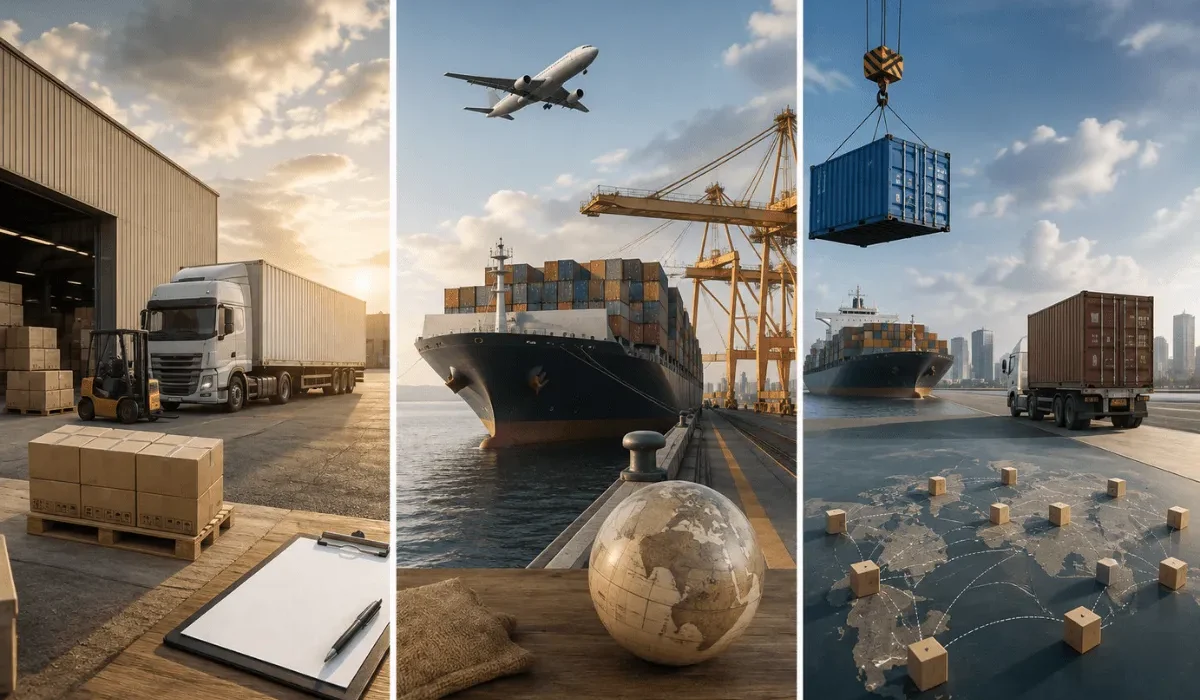
Incoterms® are often treated as shipping abbreviations.
They are much more important than that.
Incoterms® 2020 are a set of standardised international trade rules published by the International Chamber of Commerce. They define important responsibilities between buyer and seller, including delivery, costs, risk and certain transport-related obligations.
The key is understanding what they do not mean: an Incoterm does not by itself define the complete commercial contract, price, payment terms, product specification or transfer of ownership.
EXW — Ex Works
Under EXW, the seller generally makes the goods available at a named location. The buyer takes on a substantial share of transportation, export and import responsibilities.
Because of this allocation, ICC notes that EXW is primarily suited to domestic trade and can create practical complications in export transactions.
FOB — Free On Board
FOB is used for sea or inland waterway transport where delivery occurs when the goods are loaded on board the vessel nominated by the buyer.
Once the goods are on board, the risk transfers to the buyer.
CIF — Cost, Insurance and Freight
Under CIF, the seller arranges and pays for carriage and insurance to the named destination port. However, the point at which risk transfers is earlier—when the goods are loaded on board the vessel.
This distinction between who pays and when risk transfers is one of the most important concepts buyers need to understand. ICC also notes that the seller’s insurance obligation under CIF is limited to minimum cover unless otherwise agreed.
Why this matters
Two suppliers can quote the same nominal price using different Incoterms and create very different landed-cost outcomes.
A strong buyer therefore asks:
Where does delivery occur? When does risk transfer? Who pays freight? Who handles customs? Who arranges insurance?
Incoterms® make these responsibilities clearer—but only when the parties choose and document the term correctly.

0 Comments